
Echosounders are valuable tools for mapping pond geometry, but they are often asked to do more than they can reliably deliver. When the goal is to measure sludge volume, the core challenge is not collecting a depth point; it is determining which acoustic return represents the true pond bottom, which return represents the top of the sludge layer and how much material sits between them. In real-life ponds, that distinction is rarely clean enough to trust sonar alone.
The persistent problem with sonar is accurate interpretation of sludge build-up. A pond may contain soft floc, consolidated sludge, uneven liner surfaces, and debris. In addition sludge contains entrained gases such as H2S from decaying organic matter or industrial process waste. Each of these conditions can change how sound travels and reflects. A depth number coming out of an instrument may look precise, but precision is not the same as accuracy when the acoustic target is ambiguous.
What Echosounders Can and Cannot Resolve
Single-beam multi-frequency and dual-frequency sonars can distinguish water from sediment typically without much difficulty depending on noise in the water column. Lower frequencies may penetrate farther into soft material than higher frequencies, while higher frequencies may provide a sharper return from the upper sludge-water interface. That makes multi-frequency data useful as part of a sludge survey, especially when the operator can inspect the raw acoustic response.
The limitation is that sludge penetration is conditional on several factors including sediment/sludge type, density and thickness and pond liner type. The sonar must export raw echogram data, not just finished depth values since the latter is susceptible and in fact prone to picking up outliers from water column artifacts such as bubbles, weeds or debris. The acoustic post-process software must also allow the user to interpret the echogram and manually trace relevant layers, including the pond bottom where it is visible. Instruments that simply output depths are highly susceptible to outliers and false measurements that can be hard to detect after the fact. The echogram image below shows how the top of sludge surface may be clear but the hard pond bottom or liner, may not be.
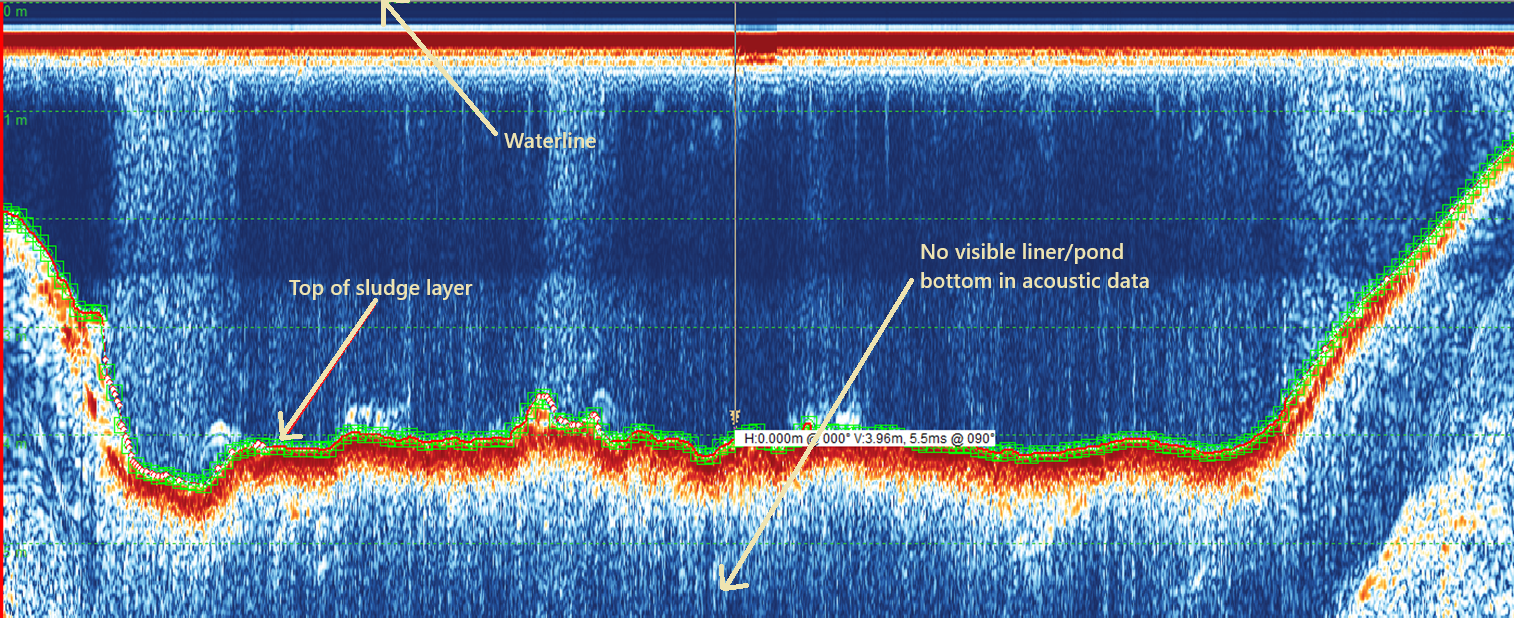
In the echogram above there is no obvious visible liner - the liner of this pond must be measured manually
Calibration Is Not Optional
Sonar interpretation also depends on sound velocity. At minimum, sonar data needs to be calibrated to the speed of sound in the water column. Temperature, conductivity and depth affect travel time, and travel time is what the sonar converts into distance (depth).
The problem becomes harder when the survey relies on acoustic penetration through sludge down to the liner or natural bottom. In that case, the relevant sound speed is no longer just the water column. The sludge layer has its own acoustic velocity profile, and without understanding that profile, thickness estimates can be distorted. A return that appears deeper on the echogram may not translate cleanly into true physical liner depth unless the propagation environment is known.
Gas Makes Sludge Especially Difficult
One of the most important practical constraints is entrained gas. Pond sludge often contains gas bubbles generated by biological activity. Gas reflects and scatters sound, which can block the sonar from seeing through the sludge layer. This is especially problematic in consolidated sludge and in deposits thicker than about 20 cm, where acoustic penetration can become inconsistent or fail altogether.
When gas is present, the echogram may show a strong reflector that is not the liner, or it may lose the deeper return entirely. The operator may still see a convincing boundary, but that boundary can represent the upper gas-rich sludge zone rather than the true bottom. This is where sonar-only workflows are most vulnerable: the data can look authoritative while measuring the wrong interface.
The True Pond Bottom (Liner) is Hard to See
The pond bottom itself also affects interpretability. Hard, reflective surfaces such as HDPE liners, concrete, or rock tend to produce clearer echogram signatures. These surfaces can give the operator a better chance of identifying the liner beneath soft sediment when acoustic conditions are favorable.
Clay and naturally lined bottoms are harder to interpret. They may not produce a sharp, consistent reflector, and their acoustic signature can blend into overlying sediment. In those ponds, even raw echogram review may not be enough to separate sludge from bottom with confidence.
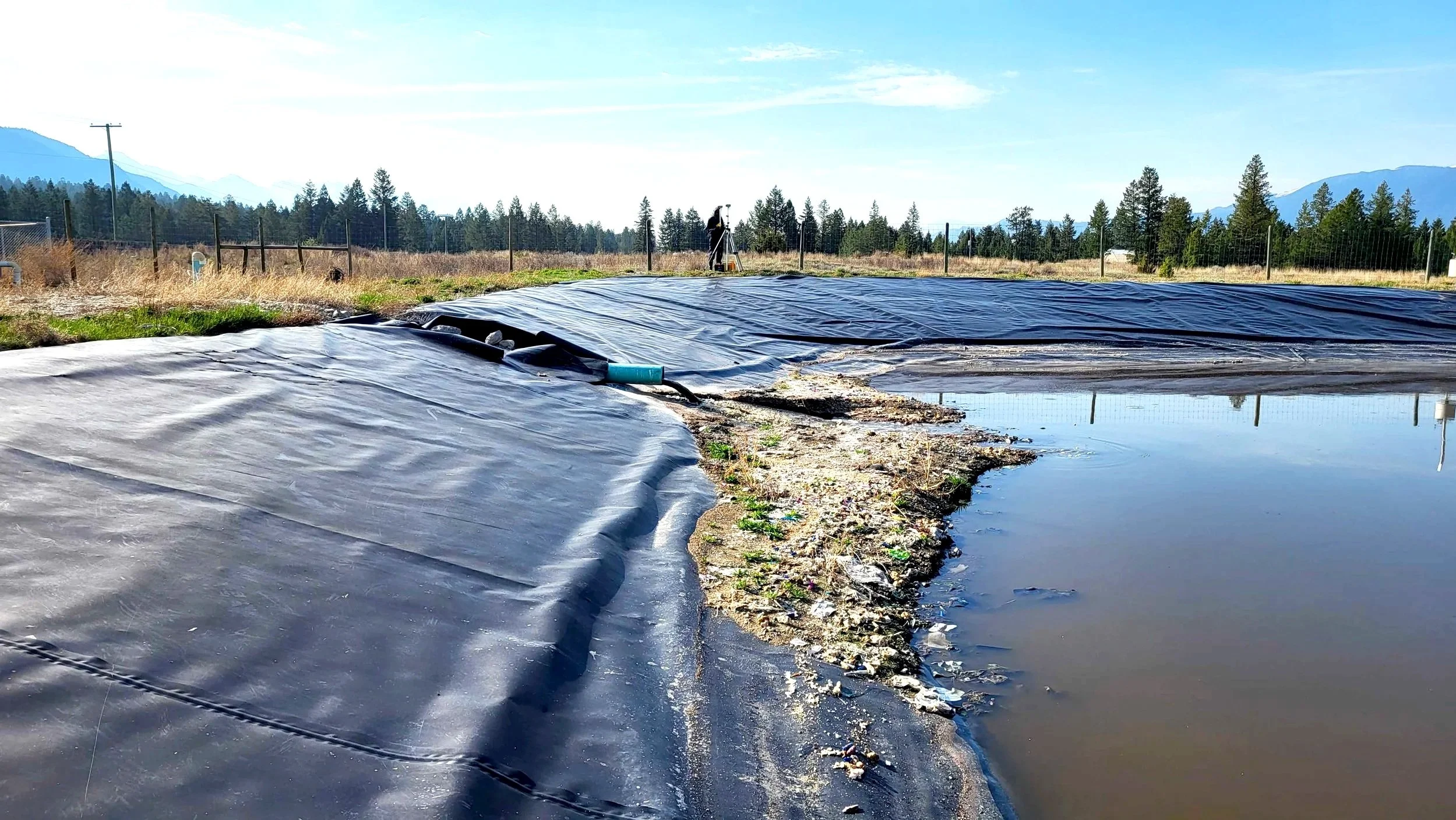
Some ponds are lined with HDPE (plastic), which under the right conditions provide clear acoustic returns
False reflections can commonly be interpreted as the pond liner. A false reflection can occur when sounds reflects twice off the bottom of the pond but is received by the sonar after the second reflection (the first reflection can bounce off the bottom of the boat). This false - or second - reflection can appear as a deeper bottom below the original bottom reflection on the echogram causing it to be incorrectly interpreted as the liner of the pond. The image below shows a false reflection in an echogram.
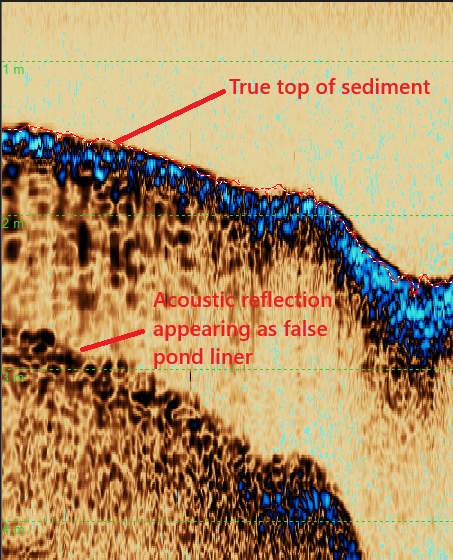
Although this echogram appears to display a lower second layer, this is actually a false acoustic return
Why Physical Measurements Still Matter
If echosounders are unreliable as a standalone form of determining the sludge-volume method, the answer is not to discard sonar entirely. The more accurate approach is to physically measure the pond bottom. When performed properly, direct physical measurements are far more dependable for confirming liner dimensions than relying on sonar to penetrate through the sludge.
Physical liner measurements can also provide an independent reference for what the acoustic data is showing. They can confirm whether the lower traced echogram boundary is the liner or a false reflection. Sonar data is still critical to determining the top of the sludge layer in high resolution and both generated surfaces (top of sludge and liner) can be used for more accurate volume calculations.
The Takeaway
Echosounders are useful, but on their own they shouldn’t be relied upon for accurate sludge quantification. Raw echograms, manual interpretation, sound-speed calibration, sludge velocity assumptions, gas content, and liner material all affect whether sonar can identify the true pond bottom. For accurate sludge-volume work, the most defensible method combines acoustic mapping with properly executed physical liner measurements.